Collaboration key to building resilient communities to withstand disasters

There is some talk about collaboration as a strategy to build resilient society.  Translating that talk into action is another matter. Regardless, every bit of effort in right direction counts.  Therefore we think it is worth sharing this article published in Canadian Underwriter which cited Steven Blaney, Canada’s minister of public safety and emergency preparedness. As Mr Blaney was quoted saying “Canada’s evolving approach to emergency management means our government is shifting from a reactive model to one that allows us to better identify risks related to natural disasters, and to take steps to eliminate or reduce these risks and their impacts before a disaster strikes”.  Below is the article;

Collaboration key to building resilient communities to withstand disasters

A year ago Toronto was hit by ice storm making it one of the costliest disasters.  Photo: Alex Urosevic for National Post:  Power lines and CN Tower viewed through ice covered branches in Scarborough, December 23, 2013

A year ago Toronto was hit by ice storm making it one of the costliest disasters.
Photo: Alex Urosevic for National Post:
Power lines and CN Tower viewed through ice covered branches in Scarborough, December 23, 2013

Earthquake preparedness demands taking steps now to build resilient communities that can better withstand and recover from the impacts of natural disasters and other emergencies, Steven Blaney, Canada’s minister of public safety and emergency preparedness, emphasized during a speech in Vancouver yesterday. Speaking at an earthquake symposium hosted by the Insurance Bureau of Canada (IBC), Blaney called on all levels of government, industry, academics and the public to work together on earthquake preparedness strategies…

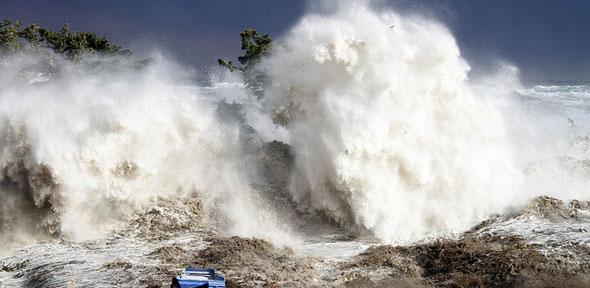
25 Devastating Effects Of Climate Change

disasrer induced displacement

I found this article by Leslie Baehr, Chelsea Harvey published recently in the Business Insider (Australia) which I think makes for mandatory sharing.  The authors make a compelling case with a list of issues that are already taking serious toll on socio-economic sustainability globally. 


The world is getting warmer and that’s already causing disasters that will devastate lives and cost hundreds of billions of dollars. Those problems are only getting worse, as shown by recent reports from the United Nation’s Intergovernmental Panel On Climate Change (IPCC) and the White House, among others. The greenhouse gas emissions that drive warming “now substantially exceed the highest concentrations recorded in ice cores during the past 800,000 years,” the IPCC said. Atmospheric carbon dioxide levels, which primarily come from the burning of fossil fuels, have risen 40% since preindustrial times…READ ON

Research shows the behaviour of business leaders could be directly linked to their experiences in childhood

I found this piece on phys.org and it immediately reminded me of a number of people whom I’ve met over the years during disaster response, recovery and resilience building activities.  The research results described in this piece are telling in so many ways.  Hope you enjoy it!

Tsunami Hits Minamisoma. Credit: Warren Antiola via flickr

Tsunami Hits Minamisoma. Credit: Warren Antiola via flickr

What makes a great leader? Effectiveness? Experience? Volcanoes? It might seem unlikely, but new research from a team of academics, including Raghavendra Rau, Sir Evelyn de Rothschild Professor of Finance at Cambridge Judge Business School, suggests that experiencing a natural disaster at first hand during your early childhood can have a profound impact on your strategic and tactical decisions in later life. The team studied the impact of natural disasters on leading CEOs and, remarkably, found that those who experienced a number of moderate disasters actually had a greater appetite for risk-taking than those who had experienced none (unsurprisingly, those who experienced the most extreme natural disasters were most risk averse). It also found that they were more likely to take on more risk in response to a threat to the business…READ ON

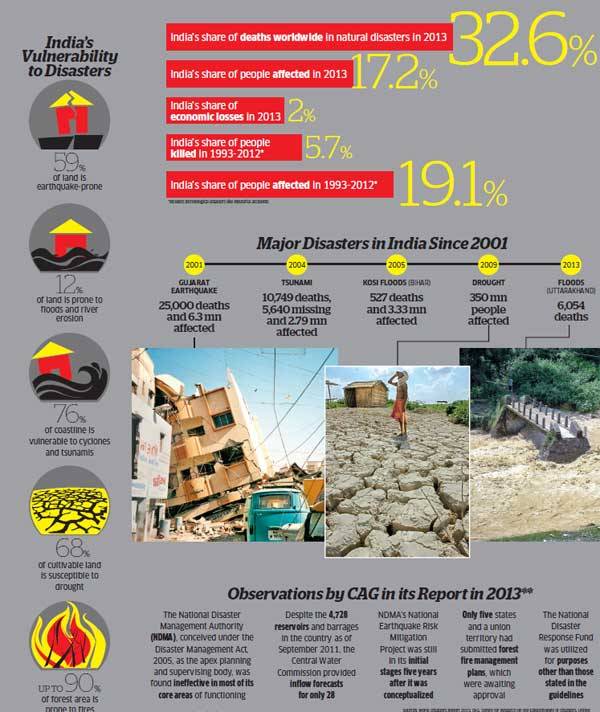
India’s top 10 natural disasters in recent years & where it stands on the global map

India disasters infographic

The recent floods in Jammu and Kashmir have caused over 200 deaths and have blocked access to basic services for more than a million people. The government, with the help of the armed forces, has rescued 1,30,000 people. The floods are yet another reminder of the increasing frequency of disasters, increasingly linked to climate change and unchecked development, and India’s inability to cope


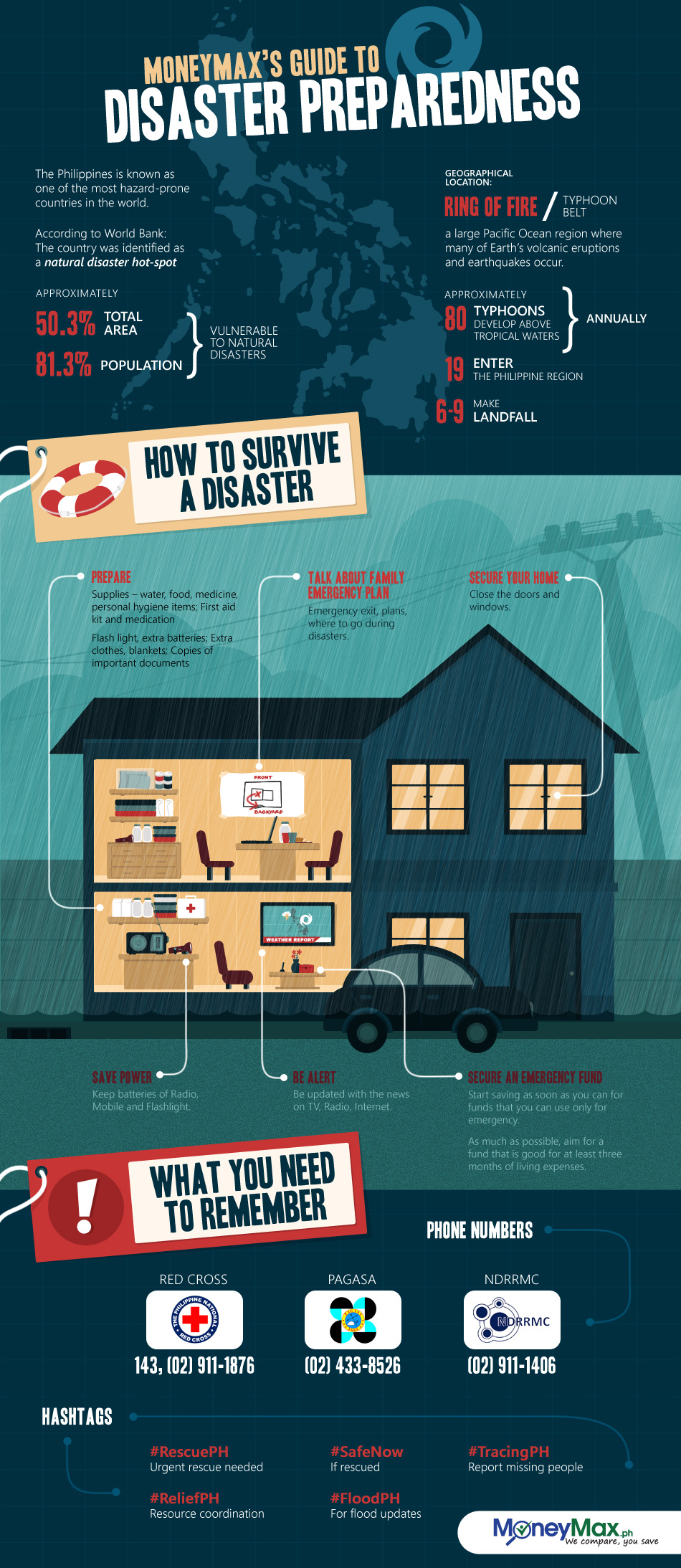
How to prepare for and survive a disaster

This infographic is part of the article written by MoneyMax, the Philippines’ major platform for comparing financial and telecom products and services for ABS-CBNnews.com. Full article can be read is available at Resilience Reporter or here

how to survive

Cost of disasters (infographic)

Balcombes Claims Management recently shared an infographic displaying the catastrophic costs around the world caused by natural disasters. From earthquakes in Japan, China, and Haiti, to the ongoing typhoons in Indonesia, the financial amounts are staggering. Can the economic toll from future disasters like these be reduced?

100 Resilient Cities Challenge

Is your city ready to become resilient?

100 Resilient Cities Initiative will be better off with Brisbane as part of it.  Photo: JD

100 Resilient Cities Initiative will be better off with Brisbane as part of it. Photo: JD

The 100 Resilient Cities Challenge seeks to find 100 cities that are ready to build resilience to the social, economic, and physical challenges that cities face in an increasingly urbanized world.

We can’t predict the next disruption or catastrophe. But we can control how we respond to these challenges. We can adapt to the shocks and stresses of our world and transform them into opportunities for growth. If your city applies for the 100 Resilient Cities Challenge, it could be one of 100 cities eligible to receive funding to hire a Chief Resilience Officer, assistance in developing a resilience strategy, access to a platform of innovative private and public sector tools to help design and implement that strategy, and membership in the 100 Resilient Cities Network.

The deadline to apply is September 10, 2014. Ignite the urban resilience movement.

Source: http://www.100resilientcities.org/pages/100-resilient-cities-challenge?utm_medium=email&utm_source=RockefellerCentennial&utm_content=2&utm_campaign=20140723applicationsopen&source=20140723applicationsopen

Preparing Your Home For A Natural Disaster [infographic]

In this infographic, HouseLogic, a website for homeowners from the National Association of REALTORS®, shows just how damaging these natural phenomena can be, and how to make sure you and your home are ready.  Continue reading by clicking below link to the source of the article. [Source: http://dailyinfographic.com/preparing-your-home-for-a-natural-disaster-infographic%5D

infographic disastar


Collaboration: An emerging dominance in disaster resilience

100_resilient_cities

The emergence of the disaster resilience narrative over the past 15 years has been a slow process. It has been challenged by both the policy and practice arms of disaster management jargon in Australia, despite some outwardly significant projects aiming to establish a disaster resilience dialogue as an integral part of the way the country deals with natural disasters whose frequency has created disruptions previously not witnessed. The Rudd Government introduced Australia’s first national funding program, the Natural Disaster Resilience Program, which provided over $70 million to states who then subsidised this to create a four year resilience funding program aiming to jump-start the development of a resilience culture in Australia. In early 2011, only a few weeks after the historic Queensland floods and just days after Cyclone Yasi, COAG adopted the National Strategy for Disaster Resilience. Since then there has been an emergence of disaster resilience portfolios within some state governments as a further indicator that disaster resilience is serious…READ ON